
Double Materiality Assessment
Belimo's 2024 double materiality assessment (DMA) identified 13 key sustainability topics through a comprehensive evaluation of financial risks and opportunities, environmental and social impacts. This assessment aligns with the European Sustainability Reporting Standards (ESRS) and the Corporate Sustainability Reporting Directive (CSRD). Its results form the basis of Belimo's sustainability strategy, targets and metrics.
Background
To meet the requirements of the European Union's CSRD and ESRS, Belimo revised its materiality assessment methodology in 2024. The double materiality assessment (DMA) conducted for the first time helped to define the sustainability topics that are material for Belimo’s business and its stakeholders.
This approach combines an outside-in with an inside-out view. While financial materiality considers risks and opportunities that may affect the Company financially (outside-in), impact materiality focuses on how its activities affect the environment and society (inside-out). The assessment covers Belimo's full operations and value chain. Stakeholder engagement was integral to the process, ensuring an inclusive balanced approach.
Further information on the methodology can be taken from the Sustainability Notes.
Outcome
List of Topics
As the result of the DMA, the following 13 sustainability topics were found to be material for Belimo:
Environmental Topics | Social Topics | Governance Topics | ||
|---|---|---|---|---|
Climate Change | Occupational Health, Safety & Wellbeing | Data Privacy & Cybersecurity | ||
Energy Management | Talent Attraction, Development & Retention | Digitalization | ||
Contribution to Energy Efficiency | Social Responsibility & Human Rights in the Supply Chain | Innovation & Solution Leadership | ||
Environmental Footprint of Supply Chain & Traceability | Occupants’ Health, Safety & Wellbeing | Product Quality, Safety & Compliance | ||
Circular Economy |
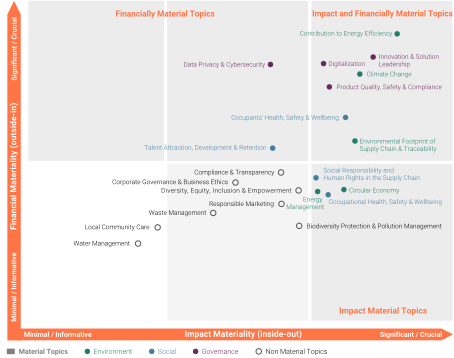
Double Materiality Assessment Matrix
Stakeholder Perspective
Customers identified energy efficiency, climate change, and supply chain-related issues as the most relevant topics, while investors prioritized corporate governance and business ethics. Suppliers emphasized the need to address climate change and data privacy, academia highlighted digitalization, and associations and public organizations stressed the importance of energy efficiency and climate actions to reduce greenhouse gas (GHG) emissions, thereby supporting global climate targets and improving air quality.
Contribution to Energy Efficiency, Digitalization and Innovation & Solution Leadership were assessed as the material topics with the highest financial opportunity for Belimo, while Data Privacy & Cybersecurity and Product Quality, Safety & Compliance were associated with the highest financial risk.
A high positive impact on society and/or the environment was linked to the topics of Contribution to Energy Efficiency and Innovation & Solution Leadership. Meanwhile, topics such as Environmental Footprint of Supply Chain & Traceability and Climate Change were identified as having the highest potential for negative impacts.
ESRS Topical Standards
The following ESRS topical standards are deemed to be applicable to Belimo:
Environment | Social | Governance | ||
|---|---|---|---|---|
ESRS E1 Climate Change | ESRS S1 Own workforce | ESRS G1 Business conduct | ||
ESRS E5 Resource use and circular economy | ESRS S2 Workers in the value chain | |||
ESRS S4 Consumers and end-users |